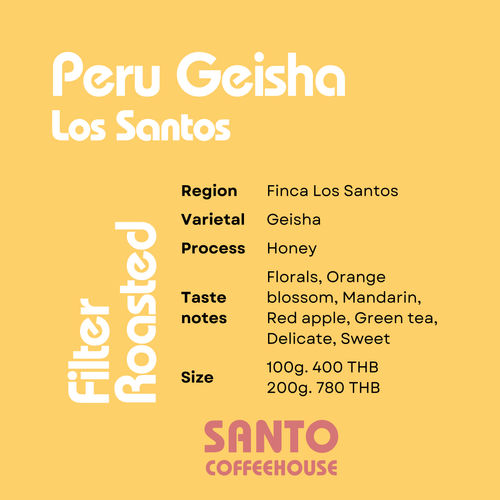
Peru Geisha Los Santos Honey Process - Roasted for Filter
Bag Size
Detail
- Brewing Method
- Pour Over/Filter
- Roast Level
- Light
- Type
- Single Origin
- Taste Notes Detailed
- Florals, Orange Blossom, Mandarin, Red Apple, Green tea, Delicate
- Coffee Origin
- Peru
- Coffee Province / Region / Town
- Finca Los Santos
- Coffee Process Detailed
- Honey
- Coffee Species
- Arabica
- Coffee Variety
- Geisha / Gesha
- Coffee Altitude
- Above 1,500 MASL
Description
During the first half of 18th century the arrival of the early coffee plants in American continent, triggered the coffee production in Perù, in particular in Moyobamba, Jaén and Chanchamayo regions beside Andes mountains. Initially this production was concentrated on Typica variety and it was almost totally destinated to the domestic consumption. Since 1850 the plantations that are dedicated to the cultivation of many crops were turned in coffee monoculture. However only with the introduction of further varieties as Bourbon, Caturra and Catimor the exportations greatly grew up thanks to the many actions designed to create transport facilities and inner transfers. Moreover, thanks to European's aid and expecially the English one Peruvians farmers had the possibility to enhance quality of their products. In the area around Chanchamayo valley the number of beneficious able to process coffee, quickly grew up, becoming and being appreciated as zona cafetera all over the world.
Unfortunately Peruvian development slowed down for many years due to both economical and political instability even if in the last decade producers, as we say above, invested a lot on their products' quality. The major propulsion to this was given by the creation of cooperatives made up of small producers and by the support of private associations like “Camara Peruana de Cafè”, whose main purpose is the promotion of the peruvian coffee image in the international market and the improvement in local producers "skills with a fitting training".Today coffee in Perù is cultivated in a 230.000 hectare area in 210 different distrects and constitue 12% of all agricultural exports which is the most important for Peruvian economy.
If today Perù is the second organic coffee producer country (that is produced without chemical fertilisers) the credit is for large part to microclimatic conditions and Inca civilization that exploited the enormous potential of it. The origin of this tradition that isles around peruvian coast were a natural reserve of guano, an organic fertiliser rich in nitrate, phosphate and mineral salts which was used a lot until last century. The term “guano” derives from quechua language from wanu Andes and it means “bird feces”. Chincha isles located along south-west coast are within an extremely rich ecosystem thanks to Humboldt current which flows to the equator. From here comes about 20% of the fishery products and that is why it is populeted by a great amount of winged animals. Here guano was used by Incas for several years as fertiliser long before the european conquistadores' arrival. The discovery of these resources by settlers was useful to begin exportation of them and made a start for so called Guano Age, two decades of prosperity and development for the country that began in 1845 under the administration of Ramon Castilla president. Today organic coffee in Perù follows traditional practices derived from Incas and for this reason today is one of the most appreciated in the world.